Best Books about Polar Regions for Preschoolers
The polar regions have always grabbed my daughter’s interest. She loves the animals, loves the snow, loves the idea of it being cold all the time. In the winter we often focus some of our preschool lessons around the different polar regions. Here’s a list of our favorite books for toddlers and preschoolers about polar regions that we’ve used in our own home to further our daughters’ understanding of the arctic and Antarctica.
Affiliate disclosure: As an Amazon Associate I earn from qualifying purchases.
Books About Polar Regions For Toddlers and Younger Preschoolers

Interactive Books
Even though lift-a-flap and textured books are often advertised for babies, preschoolers still rely on their senses to take in new information and to really process it. Therefore, I keep the so-called “baby books” in rotation for BOTH of my girls. As long as they’re engaging with it- there’s no upper age limit for me.
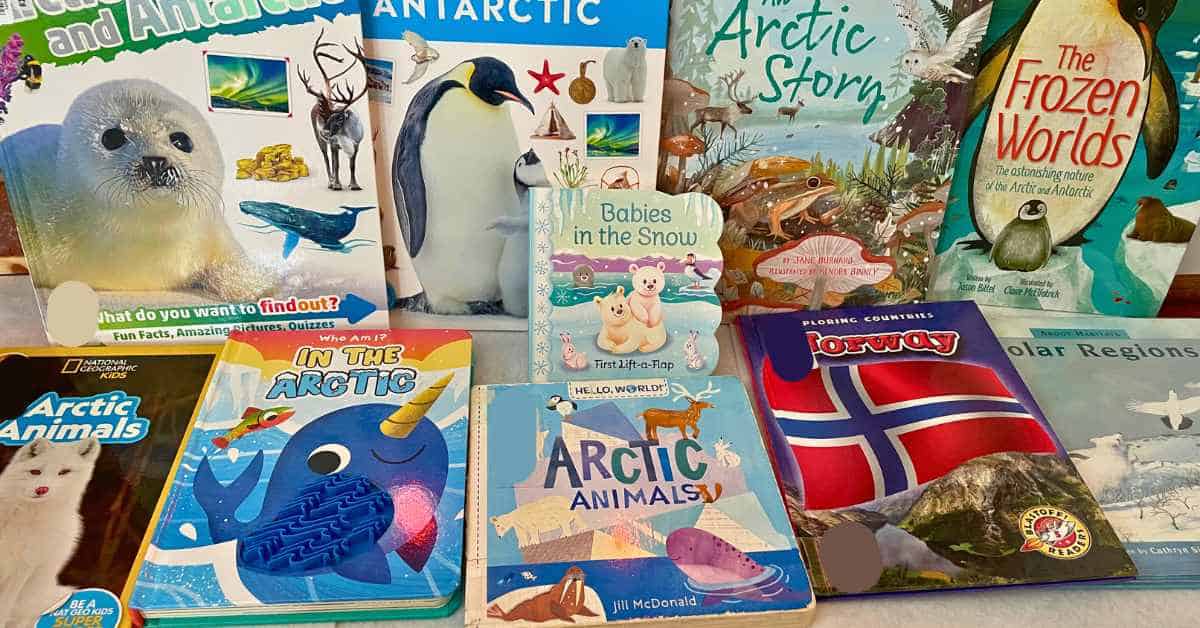
Babies in the Snow (First Lift-a-Flap)
I gave this book to my younger daughter when she was a baby and she’s loved it ever since. Her older sister also still asks to read it even though she’s a preschooler. The flaps are chunky and easy to lift and the illustrations couldn’t be any cuter.
Two little polar bear cubs go on an adventure meeting baby animals in the Arctic. It’s cute, adorable, and a great interactive book to introduce the idea of arctic animals.
It’s available on Amazon here.
Who Am I? In the Arctic
Another book I bought for my daughter as a baby, but one that they both still gravitate to. This book features a rhyming pattern with clues about each animal. Each animal also has rich, silicone, textures that are engaging.
It’s available on Amazon here.
For Introducing Animals of the Polar Regions
The animals of the polar regions are what first grabbed my daughter’s attention, so I made sure to include several books about the different animals in both the arctic and Antarctica. These are some of our favorite (and simple) books about the animals of the polar regions for toddlers and preschoolers.

Hello, World! Arctic Animals by Jill McDonald
Hello, World! are is one of my favorite series to use to introduce nonfiction concepts to my older toddler and young preschooler. It is often one of the first series I turn to, and Arctic Animals was exactly what I was hoping for.
The illustrations are characteristically colorful and the facts are straight to the point. This book does a great job of introducing a wide variety of Arctic animals such as narwhals and puffins.
It’s available on Amazon here.
National Geographic Kids Arctic Animals by Jennifer Szymanski
I love the real photos in National Geographic books. Again, these books have simple, short facts set against engaging photos of wildlife. Offering a little more detail than the Hello World! book, this is a great complement.
It’s available on Amazon here.
Ocean Animals: Penguins from Blastoff! Beginners
To help my daughter begin to sort animals between the the arctic and Antarctica, I turned to the Blastoff! series for a book about penguins. The facts are simpler than the National Geographic book but the photography is just as engaging.
National Geographic also has a book on penguins if you’re looking for an exact match with Arctic Animals, which is available on Amazon here.
Books About Polar Regions For Older Preschoolers

Animals of the Frozen North: An Arctic Story by Jane Burnard
The illustrations in this book are absolutely GORGEOUS. This book tells the story of the animals of the arctic and how they all interact together in the ecosystem in the form of a picture book.
While it is definitely longer and wordier than most picture books, the words are so lyrical that is swept my daughter up in its cadence. This is a book that is meant to be read aloud.
It’s available on Amazon here.
For Comparing and Contrasting the Arctic and Antarctic:
About Habitats: Polar Regions by Cathryn Sill
If you are looking for the simplest way to start to introduce the idea of comparing and contrasting the polar regions, this book is the way to go. Each page has full page illustrations with only one line of text to accompany it. It is incredibly simple and accessible for preschoolers.
Additionally it mainly focuses on animals and the physical geography- both concepts which are easy for the youngest learners to grasp.
It’s available on Amazon here.
Find Out! Arctic and Antarctic
If you’re looking for more nonfiction content or you want to show your children actual photos, I recommend including either this book or Eyewitness: Arctic and Antarctic.
Honestly, either this book or the Eyewitness book are probably interchangeable and I don’t see a huge need to double up on them.
However, if you’re trying to decide between them, the Find Out book features actual photos with short facts on each page. The majority of the book focuses on different types of animals. The last portion of the book includes information on polar explorers, research efforts, and conservation efforts.
I enjoyed this book because it emphasized to my daughter that these are areas that are crucial to protect.
However, the structure of it tended to lead the information to be a bit jumbled about whether they were talking about the Arctic region or Antarctica. I wish the organization in the book had been clearer to make it very easy to compare and contrast between the two regions.
It’s available on Amazon here.
Eyewitness Arctic and Antarctic by DK Publishing
Similar to the Find Out book, this book features actual photos set amongst facts. This is another book that I would recommend just having for reference or for younger children to flip through and look at the pictures.
It also did a great job of talking about what life is like in both the Arctic region and for researchers in Antarctica.
Additionally, its structure was a bit more organized, making it easier to compare the two regions.
However, I didn’t think that it did as good of a job of introducing the idea of conservation efforts as the Find Out book did.
It’s available on Amazon here.
The Frozen Worlds: The Astonishing Nature of the Arctic and Antarctic by Jason Bittel
This is a book that is best used for reference, but is beautifully done. It features real photos mixed in with beautiful illustrations to create absolutely captivating pages. While it is purely nonfiction, the beauty of the images grabbed my daughter’s attention.
Additionally, this book includes facts on exploration of the polar regions, which was something that my daughter really found interesting (and let this book stand out from the rest.)
I would recommend it to have on a shelf to flip through for younger learners or to use as a reference book for elementary aged students.
It’s available on Amazon here.
For Culture:

In addition to teaching my kids about the environment and the animals of the polar regions, I also want to introduce them to the culture of the peoples that live in the Arctic region. There are A LOT of options here, but I chose to focus on northern European countries. My daughter particularly is interested in Norway (honestly- I have no idea why), so I let that guide me.
Norway (Blastoff! Readers Exploring Countries)
The Blastoff series is a great way to introduce nonfiction to a preschooler. The books feature full page, full color photos that captivate attention. The wording is simple and easily adaptable for different ages. For young preschoolers, we just talk about what’s going on in each picture, but for elementary aged students, these are a great way to really incorporate more academic vocabulary. (There’s even a glossary and an index in the back if you’re teaching your child how to navigate text features.)
Each Exploring Country book focuses on the physical geography, the animals, and the culture of the country it’s focusing on. My daughter also loved that Norway included a page on the Northern Lights. (Seeing the Northern Lights in person is something that is high on her goal list!)
It’s available on Amazon here.
The Christmas Book Flood
I’m in love with this book. I know it’s more Christmas themed than Arctic themed on the surface, BUT, it is just too lovely to not include here. It describes the tradition that many northern European countries have of exchanging books on Christmas Eve and then reading all night long.
This book is magical. It encapsulates the magic of reading the perfect book so well.
The illustrations are enchanting and many pages feature the Northern Lights.
Additionally, many parts of the illustrations are created from book pages themselves. It’s just absolutely beautiful and really brings to life a Northern European tradition.
It’s available on Amazon here.
I hope within this list there’s a few great books about the polar regions for your preschooler to help them learn more!



One Comment