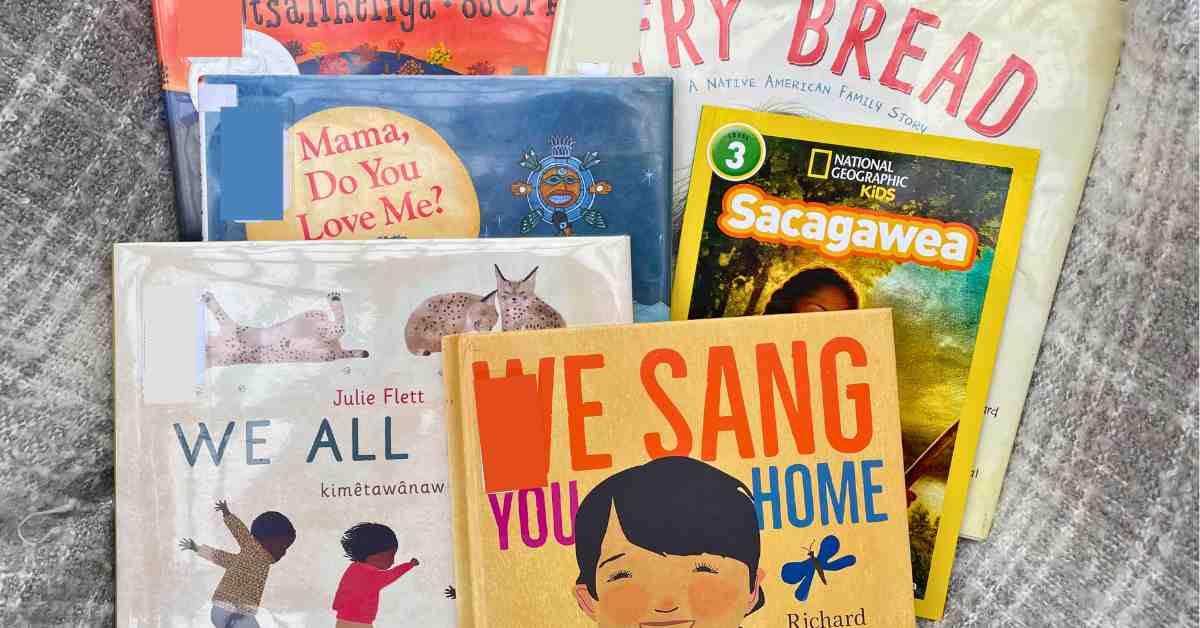
Native American Books for Preschoolers
Introducing my daughters to social studies and a wide variety of cultures at an early age is a top priority of mine. I think it’s so valuable to introduce to children the idea that Native Americans are not a monolithic people group with a homogenous culture- but rather a very diverse group. (After all, I’ve had 17-year-old students who think that all Native Americans sheltered in teepees, so this is a lesson I want to teach EARLY.)
I’ve also had students think that Native Americans don’t live in America at all anymore. So when selecting books, I wanted picture books that show Native American culture to be alive and thriving. I particularly sought out books written or illustrated by Native Americans for my preschooler.
When my oldest daughter was three we began attending historical sites that related to Native American history and she was so interested. She asked me to teach her more about Native Americans, so when November came along, I planned some of her preschool activities around Native American Heritage Month. These are some of the best Native American books for preschoolers that I’ve found to teach about their history and culture.
Affiliate disclosure: As an Amazon Associate I earn from qualifying purchases.
We Sang You Home by Richard Van Camp
A beautiful love letter for children. It’s written as a poem from parents to their children- this poem emphasizes the joy that children have brought to the family. Full of love and gratitude for family, this book is so lovely. Additionally, the illustrator relies on earth tones to create beautiful illustrations. If reading this in November during Native American Heritage Month, the aesthetic blends perfectly with late fall.
A simple poem with two lines on each page, this book is delightful for toddlers and preschoolers alike.
Additionally, for older children, you could encourage them to write their own poem to their family.
As the author is a member of the Cree tribe, this book is also available in the Cree language.
It’s available on Amazon here.

We All Play by Julie Fleet
Another beautifully illustrated poem, this book by Juile Fleet invites children to explore nature and discover how animals play- just like us.
Simple and beautiful, with only a few words per page, this is a great book for toddlers and preschoolers alike. It encourages a connection with the natural world and is just simply gorgeous.
Additionally, it includes Cree names for animals in a glossary at the end if you have older children.
It’s available on Amazon here.
We Are Grateful- Otsalihelia by Traci Sorell
This book is a beautiful picture book based on the Cherokee concept of “ostaliheliga”- or gratitude. It goes through the different seasons and introduces different scenarios in which Cherokee people express gratitude. Along the way, it also highlights different aspects of Cherokee culture and introduces some Cherokee words.
My daughter particularly liked the last page, which featured parts of all four seasons.
As we read this one in November during Native American Heritage Month, it also tied in nicely with our discussions of gratitude as we neared Thanksgiving.
While I’ve not read them yet, there are also board book versions of this book for any younger learners you may have in your home.
Lastly, the author has different resources on her website at www.tracisorell.com. If you’re looking for additional learning activities that connect to the book, be sure to check out her website.
The book is available on Amazon here.

Fry Bread: A Native American Family Story by Kevin Noble Maillard
Winner of the Robert F. Sibert Medal, this rhyming book introduces to preschoolers all the different meanings that fry bread (a traditional Native American food) can have to families.
One part I really enjoyed was when the book listed numerous different tribes in different geographic places.
We talked briefly about where some of the tribes are located. This conversation led to a preschool lesson that we did on how different tribes lived in different styles of shelters based on their physical geography. (The activity is available here:)
Also, while it does not fully discuss the difficult history of American Indian tribes, it does hint at it. Those hints could provide an open door for some beginning conversations about more detailed history if your child is ready for that.
At the end, the author includes a recipe if you would like to make your own fry bread.
Lastly, at the end of the book, the author (who is of the Seminole Nation) discusses a little more about what fry bread means to him personally as well as more details about Native American culture, geography, and history. It’s a great resource for parents who might want to teach their children more or learn more themselves about Native American culture.
It’s available on Amazon here.
Mama, Do You Love Me? By Barbara M. Joosee
As this book is the only picture book on here whose author does not claim Native American heritage, I hesitated to include it. I want to rely on works created by Native American authors and illustrators.
However, this book was published in the 1990s and I still remember reading it in elementary school. It stuck with me that much.
In the story, a little girl asks her mother about all of these different scenarios in her imagination- and if her mother would still love her. Again and again, her mother replies “yes.”
A story that has been adapted many times over, I thought this book really spoke to the universality of family bonds.
Additionally, my daughter loved the illustrations. Set in the arctic, this book’s illustrations are unique from the other books on this list. Additionally, I love that the arctic is also included with showcasing the diversity of Native American tribes and land.
It’s available on Amazon here.
Sacagawea by Kitson Jazynka- National Geographic Kids (Level 3)

Older readers are definitely the target audience of this book. HOWEVER, the story of Sacagawea can capture the attention of preschoolers. Instead of reading every word in this text, I summarized it and we talked about the pictures.
This book includes pictures of Native American rock paintings, artifacts from the Lewis and Clark journey, landscapes of where the Shoshone people lived, and images of historic reenactors. The pictures really brought the story to life.
Sacagwea’s story is one of such courage. It’s a great introduction for children to the impact that individuals can make in historical events.
This was a great opportunity to talk about this time period of history. It was also a good introduction to talking about how we learn can history from artifacts.
Lastly, this book is great to have in the home for year after year as kids grow up. It’s adaptable and scalable.
It was a great companion for several of our other preschool themes, including our Lewis and Clark activities and our Women’s History Month activities.
It’s available here.
Closing Thoughts
While there are certainly numerous Native American books for preschoolers available, I hope this list gives you a good starting point with a wide variety. And if you’re interested in more hands-on activities for preschoolers to teach Native American history and culture, be sure to sign up for email updates for when I have those posts finished!


2 Comments