Introducing Native American History To Kids
Native American history IS American history, and I want my kids to be introduced to it as early as possible. Plus, Native American culture is a critical part of America today. So here are a few hands-on, Montessori-style ideas for introducing Native American history to kids- including preschoolers and lower primary grades.
And just a note- I planned these activities with every effort of being culturally sensitive and appropriate. I made a deliberate effort to make sure to avoid activities that would be culturally insensitive, such as using feathers in a craft when feathers are seen as sacred in many Native American cultures. Additionally, I try to avoid the pitfall of conveying the idea that Native Americans only lived in the past or the idea that all Native American culture is monolithic.
And if you’re looking for some more guidelines on “dos and don’ts” when introducing Native American history and culture, I found this article really helpful.
Affiliate disclosure: As an Amazon Associate I earn from qualifying purchases.
Learn About Native American Lodging Styles Across the United States
I’ve taught history to high schoolers for over ten years- and I have to tell you- when I introduce the idea every year that not all Native Americans lived in tipis- there is always a handful of kids that are SHOCKED. Keep in mind- these are students old enough to drive and possibly old enough to vote- who have been walking around their entire lives thinking every single Native American in history lived in tipis. We need to do better.
So in my house, I’m making sure that my own kids learn this early on. (I just can’t have them being old enough to vote and not realizing that Native American culture is incredible diverse.)
Plus- it’s interesting.
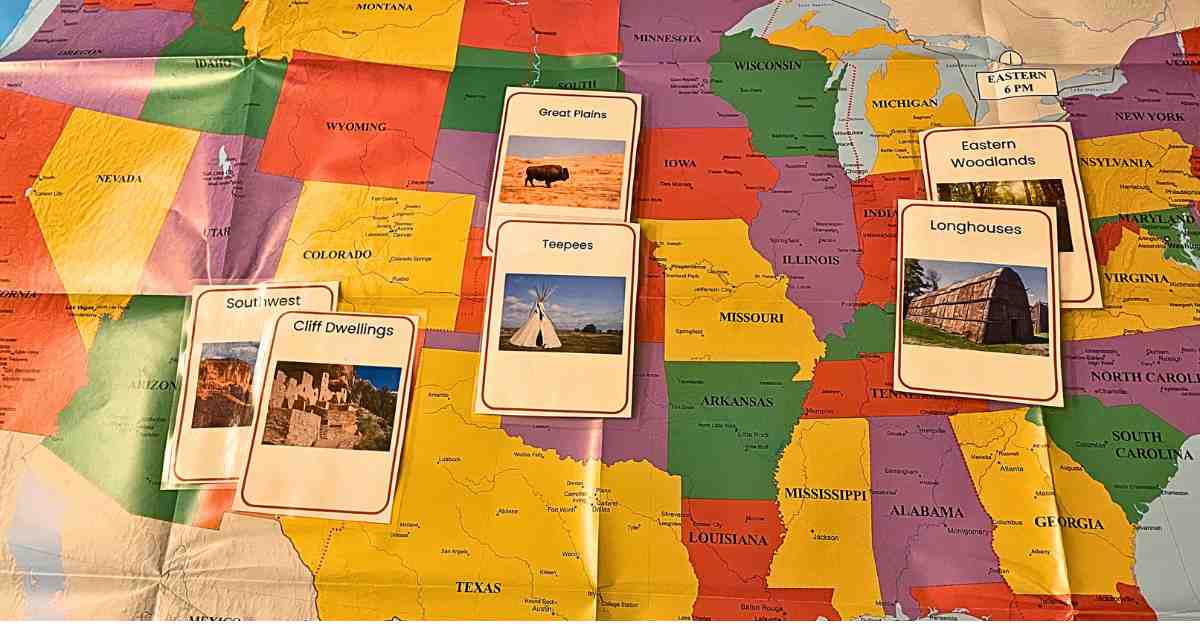
Lodging Matching Activity
I made these cards for our geography activity with different types of shelters that Native Americans used along with images of the physical environment of different regions of the United States.
I spread out a giant map of the United States (I found it for $1.25 at the Dollar Tree!!!!) and placed the physical geography cards on the map. Then I had my preschooler try to figure out which lodging style would make the most sense in each geographic area based on the environment.
I asked her questions like “what kind of materials would they have there to make houses out of?” or “What kind of weather do you think they had in that area?”
Those questions guided her to make the matches really quickly. I kept it simple with only four geographic areas that are pretty distinct from each other.
And when we did this activity, I also made sure to point out that these are historical examples.
Those cards are available here.

Visit or Learn About a Major Preservation/Heritage Center
Major preservation centers are across the United States. If you can visit one, I HIGHLY encourage you to do so. If the National Park Service runs the center, they are likely to have a junior ranger program to help elementary schoolers really begin to understand the history of the area.
Many national parks also have a connection with the local American Indian tribe there as there is often a long history between tribes and what are now federal lands. If you are visiting a national park with your family, do some extra research beforehand to learn about any tribes connected to the land and if there is any museum or educational center that is open to the public.
The key here is to make sure you’re emphasizing the fact that Native American history and culture is not a “closed chapter” but rather an ongoing part of America.
Key ones around the United States are:
- Cahokia Mounds States Historic Site in Illinois (this was the largest city in Pre-Columbian America north of the Aztec empire)
- Mesa Verde National Park in New Mexico
- Museum of the Cherokee People in North Carolina
- Crazy Horse Memorial in South Dakota
- Hopewell Mound Group in Ohio.
Preservation Center Matching Activity
If you can’t travel to a heritage center however, I did make these simple geography cards to help children match different sites with different regions across the United States. My goal here was to help my daughter understand that Native American history spans the entirety of the United States, and that different geographic places produced different cultures. I kept it simple with only four distinct places, but it paired well with looking at different lodgings.
Those cards are available here.

Learn About Native American Pottery
Pottery is a key part of many Native American cultures. Learn about how Native Americans traditionally made pottery and the purposes they used them for. Additionally, if you’re near a museum, you could take a field trip to view traditional pottery.
If you’re not near a museum, YouTube has a few great videos from Native Americans that teach the process of how they make pottery and the significance of it. I particularly enjoyed this video with my daughter.
One interesting idea you can do is to show different videos or pieces of pottery from different tribes and different geographic locations. Ask your elementary schooler what similarities and differences they notice and why they think that might be. This can be another great way to instill the idea that Native American culture is not homogenous, but very diverse.
Learn About Local Native American History
Learning about local history is a great way to pique children’s interest in history. It’s more concrete for them and it helps them become more invested in the idea of learning studying more.
One book in particular that really helped my daughter think about the concept of geographical place in terms of history was This Land by Ashley Fairbanks.
As American Indian culture and history is throughout the United States, do some research with your child about the history of the area. Look and see if there is still an active community in the region. If it’s available, attend a cultural or heritage festival.
We attended a festival that was held in conjunction between a historical site and a group whose mission is to educate people on the fact that American Indian culture is still very prominent all across the United States. There was a direct invitation to the community to come and learn more about American Indian culture through this festival. Different tribes from across the United States were represented and had different educational booths set up along with music, food trucks, etc.
Just be sure to be respectful about any rules regarding photography, videoing, etc.


Learn About Sacagawea
There is just something about Sacagawea’s story that is captivating for kids. Whether it’s her youth or her courage, Sacagawea is a great starting point to begin to introduce individuals who made a major impact on history.
The National Geographic book for kids is a great introduction to her.
Additionally, there are Lewis and Clark NPS sites across the country that would also have more information on Sacagawea. You can check out all of the trail sites that NPS has recorded here.

(And if this gets your kid interested in learning more about Lewis and Clark, you can check out the activities I have here for introducing Lewis and Clark to kids.)
Books About Native American History
When selecting books to teach about Native American culture, I really try to focus on including as many American Indian voices as possible. I want the books I choose to bring into our home to have a certain level of authenticity.
You can read more about the books I turn to the most for my preschooler here.



One Comment